Strahlentherapie des HCC
SBRT
Body Stereotaxie
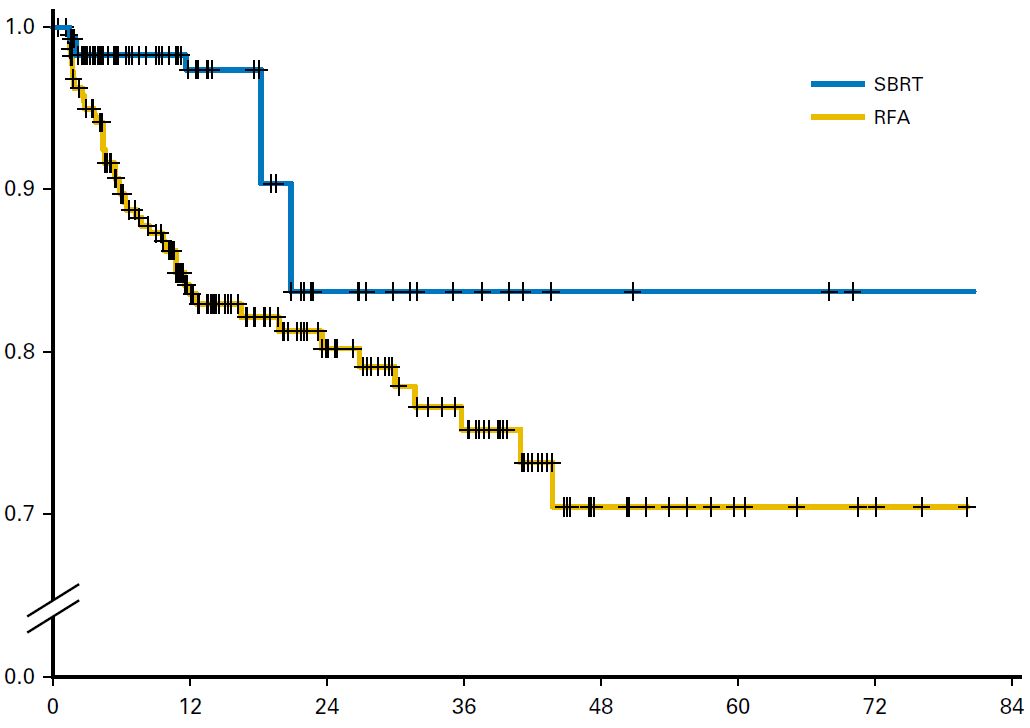
SBRT v. RFA (3)
161 wurden mir RFA behandelt, 63 mit SBRT
| Kriterium | RFA | SBRT | Bemerkungen |
| NPatienten | 161 | 63 | |
| Knoten | 249 | 83 | |
| Lebertransplantation | 34 (21,1%) | 4 (6,3&) | p = 0,01 |
| Zirrhose | 238 (95,6%) | 65 (78,3%), | p = 0,001 |
| Hepatitis C | 149 (59,8%) | 44 (53,0%) | |
| Alkohol-Zirrhose | 21 (8,4%) | 10 (12,0%) | |
| Child-Pugh A | 121 (49,6%) | 57 (68,7%) | |
| Child-Pugh B | 103 (42,2%) | 24 (28,9%) | |
| Child-Pugh C | 20 (8,2%) | 2 (2,4%) | |
| AFP, Median | 8,8 | 18,6 | |
| Tumor, Median | 1,8 cm | 2,2 cm | |
| 1a-OS | 70% | 74% | |
| 2a-OS | 53% | 46% |
Teil von
Quellen
2.) Kwong, BMC Cancer 2010
3.) Wahl DR, et al.:
Outcomes After Stereotactic Body Radiotherapy or Radiofrequency Ablation for Hepatocellular Carcinoma.
J Clin Oncol 2016;34:452-9.
doi: 10.1200/JCO.2015.61.4925.
4.)Sanuki N, et al.:
Final Results of a Multicenter Prospective Study of Stereotactic Body Radiation Therapy for Previously Untreated Solitary Primary Hepatocellular Carcinoma (The STRSPH Study).
Int J Radiation Oncol Biol Phys 2025;121(4):942−950
